top of page

Welcome to Emily's Blogs

This is where Emily will be posting her blogs for Writing and Research in Design

Blogs

Through the AIGA chapter at Elon University, I had the opportunity to hear Amy Pruitt, a brand strategist and designer, discuss the psychology of running a creative business. Her talk opened a new way of thinking about design, especially when it comes to working with clients.

In this talk, Amy outlined her typical client process. She emphasized that trust is the most important part of any client relationship. Without it, everything starts to fall apart. Even if the client has already paid, a lack of trust leads them to second-guess every little thing you do as a designer. It made me realize how much small details matter. Clients are constantly reading you, from how you present yourself to how you communicate. Even something as simple as being late or unprepared can affect how much they trust you.

Her process was also interesting because it focuses on staying in control while still making the client feel heard. She structures everything, from upfront pricing to clear steps in the project, so there is no confusion. One thing that stood out was how much she values communication. She emphasized that once the client has expressed what they are looking for, it is important to say it back to them so that both the designer and the client are on the same page. 

She also introduced us to her “magic hour,” where she presents final designs from color palette to using mockups with an explanation of her creative choices. This helps clients fully visualize the work rather than just imagine it, making decisions easier and more confident. It connects back to psychology, making the process feel real and tangible. 

Overall, her biggest message was to be authentic and not try to please everyone. You cannot control how everyone perceives you, but you can control your process and how you show up. That balance between structure and authenticity seems to be what makes her successful.


Keywords: Design Psychology, Business, Graphic Design, AIGA, Process


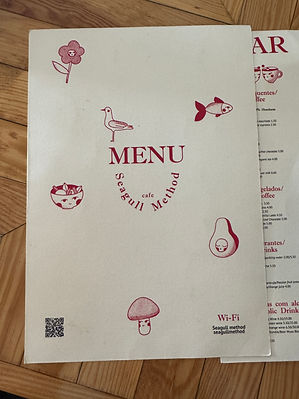
This is the menu at Seagull Method Cafe, a small hole-in-the-wall place in Lisbon, Portugal. When I first saw it, I knew I had to take a picture of it so I could reference it later. What fascinated me most about it was its simplicity and the red used. The hand-drawn illustrations, sporadically placed on the front of the menu, feel very human and relatable. This style is also very trendy right now, and for good reason. It is simple and eye-catching without being overwhelming. Additionally, the café itself was very cute and picturesque, which definitely enhanced the experience.

In class, we were asked to think about what senses our object of interest invokes, like sight, smell, taste, touch, and hearing. The first thing I notice visually is the deep red, which makes it feel elevated instead of loud, and then the illustrations that decorate the menu and seem almost random. They are cute, simple, and slightly anthropomorphic. Also, the grid system is very clear, with three columns and no strict rows. There is a lot of information, but it still feels simple thanks to a strong typographic hierarchy that uses both serif and sans-serif fonts. The titles are in all caps, red, and serif, while the body text is smaller, black, and easier to read. Being in the restaurant also added to the sensory experience. It smelled like breakfast, even though it was technically lunchtime, and the space was filled with coffee, which enhanced the laidback and relaxing atmosphere. 

I do wonder about the design process behind it. Were the illustrations created specifically for this menu, or were they reused from something else? Additionally, I know there has been an increased use of Canva due to its accessibility. So I wonder whether this is just a Canva template or was truly made from scratch. 


Key words: Menu, Design, Graphic Design, Senses, Lisbon, Cafe, Simplistic,


Updated: Mar 16

Context of Assignment

For my final project in Fundamentals of Typography, I was tasked with designing an annual report for an organization of my choice. The goal was to demonstrate an understanding of typographic hierarchy, layout structure, and how typography can guide readers through complex information. Throughout the process, I documented our design development, from early sketches to final deliverables.

I chose to create an annual report for Elon Motorsports, a club with no existing brand materials besides a logo. This meant starting with minimal structure or information. While this offered creative freedom, it also required me to determine the report’s organization and the content it should include. I built the content structure myself and used typography to clearly differentiate sections.

In addition to the report, the project included supporting deliverables that simulated a real client project. These comprised a style guide and an invoice outlining the project description, rates, and estimated hours spent.

Process

The design process started with a series of sketches exploring potential layouts for the annual report. At this stage, I focused on experimenting with page structure, typographic hierarchy, and balancing large blocks of text with visual elements. I explored different visual arrangements to keep the report engaging while ensuring readability.

Early sketches
Early sketches

Early sketches
Early sketches

One of the main challenges was gathering and organizing information. Since I was not working with a real client, I researched existing annual reports to understand typical sections, such as organizational highlights and financial summaries. This research helped shape my report’s structure and enabled me to design realistic and purposeful layouts.

After developing initial layouts, I created a rough draft of the report, which was reviewed during a class critique. My classmates offered feedback on the clarity of my typographic hierarchy and overall consistency. Some suggestions included increasing contrast between headings and body text and adjusting spacing between sections to improve organization.

Rough draft before feedback

Using this feedback, I strengthened the hierarchy and contrast, making the report easier to navigate visually.

Final Product and Reflection

The final deliverables included a completed annual report, a style guide outlining the typography system, and a client invoice. The report was the main piece, demonstrating how typography and layout can organize detailed information effectively.

This project deepened my understanding of typography in long-form design. I learned how hierarchy, consistency, and spacing guide readers through multiple pages of content. My professor noted that the final design showed a clear improvement from earlier drafts, especially in typographic clarity and overall organization.

Overall, this project enhanced both my technical typography skills and my ability to manage the full design process, from initial ideas and critique to a polished final product.

Click here to see final product.


© 2035 by Emily Novak. Powered and secured by Wix

bottom of page